Most first responders know they don't sleep well. What most don't know is that a significant percentage of them aren't just sleeping badly — they're stopping breathing dozens of times an hour while they do it.
Obstructive sleep apnea (OSA) in first responders isn't a footnote. It's an epidemic that the profession has largely normalized because exhaustion is already so baked into the job that nobody notices where the shift work ends and the sleep disorder begins.
Here's the problem: sleep apnea isn't just a sleep problem. Left untreated, it's a cardiovascular disease accelerant, a cognitive impairment driver, a metabolic disruptor, and — particularly relevant for firefighters, law enforcement officers, paramedics, and EMTs — a documented contributor to on-duty injury and impaired decision-making.
And the research on what a specific class of GLP-1/GIP medication does to sleep apnea? It's genuinely remarkable.
First Responders and Sleep Apnea: The Numbers Are Bad
Studies on firefighter health consistently show OSA prevalence rates of 35–40% — compared to roughly 10–15% in the general adult population. Law enforcement officers show similar elevated rates. EMS providers, who often carry the highest combined risk factors of any first responder group, are comparably affected.
The mechanism isn't complicated. Sleep apnea is strongly associated with obesity, chronic sleep disruption, and shift work — three things that define a first responder career.
The obesity connection. Excess weight, particularly around the neck and upper airway, is the primary mechanical driver of obstructive sleep apnea. First responders — who face cortisol-driven weight gain, metabolic disruption from shift work, and the specific body composition challenges of a high-stress profession — have elevated obesity rates compared to the general population. The weight creates the airway obstruction. The obstruction fragments sleep. Fragmented sleep disrupts the hormones that regulate weight. The cycle compounds.
The shift work connection. Rotating schedules and irregular sleep timing don't just make sleep apnea worse — they make it harder to identify and treat. A firefighter who's exhausted after a 24 attributes his fatigue to the shift. A cop who can't stay mentally sharp during afternoon patrol assumes it's the rotating schedule. A paramedic who's been fighting to stay alert on overnight calls figures that's just EMS. The sleep disorder goes unrecognized for years because the job provides perfect cover for every symptom it produces.
The cardiovascular amplification. Sleep apnea elevates cardiovascular disease risk significantly — and first responders already carry elevated cardiovascular risk from occupational stress, chronic cortisol, disrupted sleep, and shift work. Untreated OSA in a firefighter or police officer isn't just a sleep problem. It's an additional layer on a cardiovascular risk profile that's already working against them. Cardiac events are the leading cause of line-of-duty death in the fire service. OSA is one of the modifiable contributors most first responders haven't addressed.
The Science on Tirzepatide and Sleep Apnea
Here's where it gets interesting.
Tirzepatide is a dual GLP-1 and GIP receptor agonist — a medication that works through two complementary hormonal pathways to produce significant, sustained weight loss. The weight loss data alone was enough to make it one of the most studied medications in recent clinical history.
Then researchers ran the SURMOUNT-OSA trials.
Published in the New England Journal of Medicine in June 2024, the SURMOUNT-OSA phase 3 clinical program enrolled adults with moderate-to-severe obstructive sleep apnea and obesity — specifically looking at what tirzepatide does to OSA severity, not just body weight.
The results were not subtle.
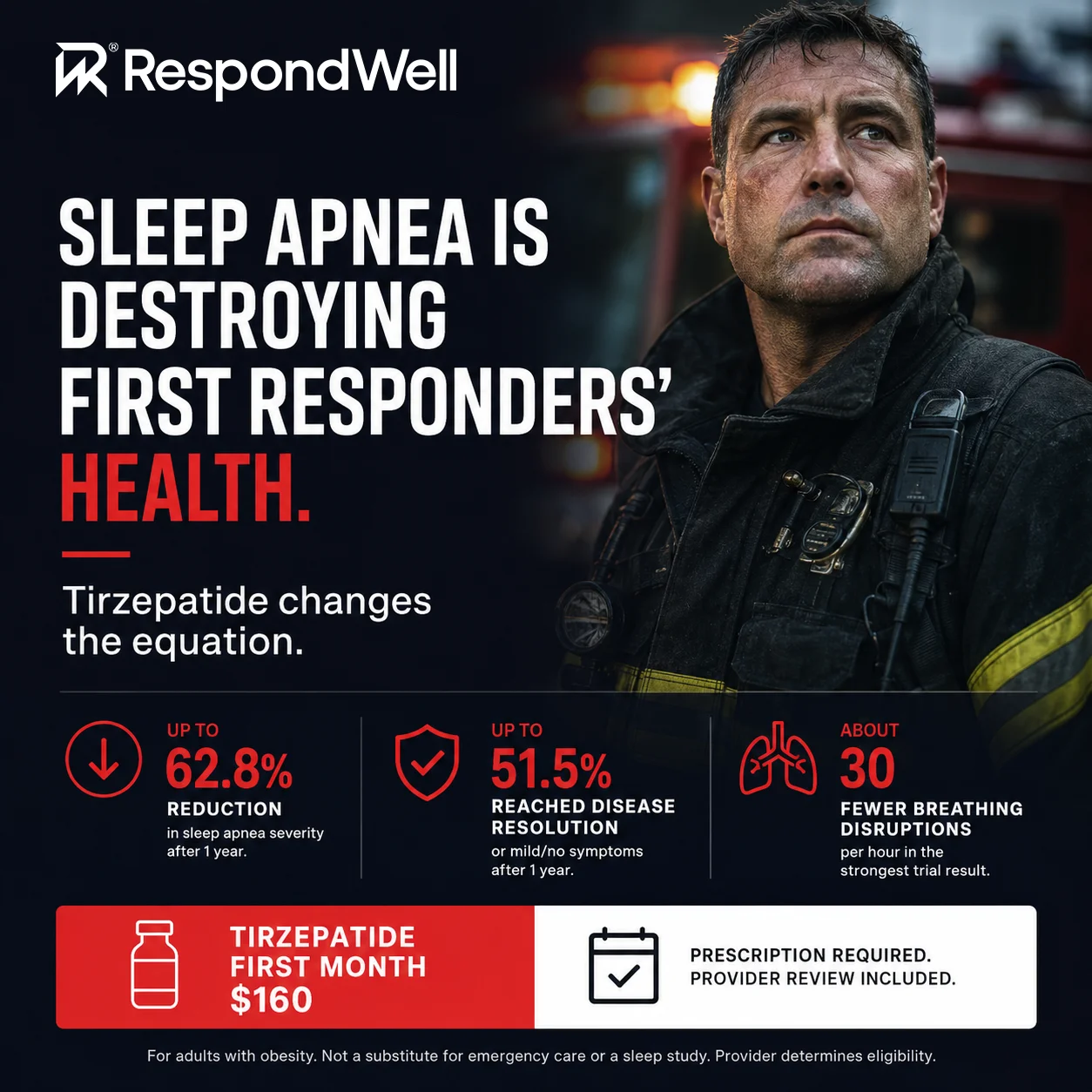
Participants on tirzepatide experienced an average reduction of up to 62.8% in apnea-hypopnea index (AHI) — the primary measure of sleep apnea severity that counts how many times per hour you stop breathing. In patients not using positive airway pressure (PAP) therapy, tirzepatide was approximately five times more effective than placebo at reducing breathing disruptions, producing around 25 fewer breathing interruptions per hour compared to placebo's five.
Up to 51.5% of trial participants met the criteria for disease resolution after one year — meaning OSA improved to the point where PAP therapy may no longer be recommended.
Beyond the breathing numbers, the SURMOUNT-OSA data showed simultaneous improvements in hypoxic burden (how much oxygen deprivation accumulates during sleep), inflammatory markers (hsCRP), and systolic blood pressure. For first responders whose cardiovascular risk profiles are already elevated, these secondary outcomes aren't incidental — they're clinically meaningful.
The mechanism isn't mysterious. Tirzepatide produces significant weight loss — average of up to 20.9% of body weight in obesity trials — and weight loss directly reduces the anatomical obstruction that causes OSA in most patients. The upper airway opens. Breathing normalizes. The downstream effects on sleep quality, cardiovascular markers, and systemic inflammation follow.
What the SURMOUNT-OSA data added was confirmation that the OSA improvement was real, measurable, and substantial — not just a secondary benefit assumed from weight loss, but a documented clinical outcome in a rigorous trial design.
"Treating the weight — meaningfully, not marginally — treats the apnea."
Why This Matters Specifically for First Responders
The combination of factors at play in OSA — obesity, shift work, sleep disruption, cardiovascular risk — maps almost perfectly onto the occupational profile of firefighters, law enforcement officers, paramedics, and EMTs.
A firefighter with untreated moderate-to-severe sleep apnea is losing effective sleep quality on every shift, accumulating cardiovascular risk that compounds with the existing occupational burden, experiencing cognitive impairment that affects decision-making on the fireground, and fighting metabolic dysfunction that makes the weight problem harder to solve.
A police officer with undiagnosed OSA is operating impaired on patrol — reaction time, threat assessment, force decision-making — in ways that neither the officer nor their department has connected to a treatable medical condition.
A paramedic who stops breathing 30 times an hour while they're trying to recover from a 24-hour shift is not recovering. They're digging a deeper physiological hole each time they sleep.
Treating the weight — meaningfully, not marginally — treats the apnea. And the clinical data on tirzepatide's capacity to produce meaningful, sustained weight loss is about as strong as anything in the modern obesity medicine literature.
The CPAP Problem
Most first responders diagnosed with sleep apnea get handed a CPAP machine and told to use it every night.
CPAP compliance rates in the general population are poor. In first responders — who sleep on recliners at the station, crash in vehicles, share bunk rooms, and work schedules that make consistent CPAP use genuinely logistically difficult — they're worse.
CPAP treats the symptom. It keeps the airway open mechanically while the machine is running. It does nothing about the underlying weight that's closing the airway. The moment the mask comes off — which for a firefighter on a working-fire shift or a medic catching sleep between calls is often — the apnea returns.
Addressing the root cause rather than managing the symptom is a different approach entirely. For first responders where CPAP compliance is structurally compromised by the job itself, it's an approach worth taking seriously.
How RespondWell Can Help
RespondWell offers compounded tirzepatide starting at $160/month (at time of publication) through our licensed independent partner providers and FDA-registered compounding pharmacies. Prescription required, following provider review of your health history.
If you've got sleep apnea, excess weight, and a first responder schedule that makes CPAP compliance a genuine challenge — this is a conversation worth having.
Getting Evaluated
RespondWell's independent partner providers understand first responder physiology and first responder schedules. The intake takes 10 minutes. There's no appointment. Your provider review is typically complete within 4 hours. Treatment ships to your door.
If you haven't been evaluated for sleep apnea, your primary care provider can order a home sleep study — it's less invasive than it sounds and can be done without a lab visit. If you already have a diagnosis and haven't found a solution that actually works around your schedule and your life, the weight loss conversation is where the real leverage is.
The science on tirzepatide and obstructive sleep apnea is in the New England Journal of Medicine. We're just making the medication accessible to the people who need it most.
The bottom line
Sleep apnea is overrepresented in first responders, the cardiovascular stakes are higher than the general population, CPAP compliance is structurally compromised by the job, and the SURMOUNT-OSA data on tirzepatide is the strongest evidence in years that the underlying weight problem is solvable — and solving it changes the apnea.
Compounded tirzepatide is prepared by a licensed, FDA-registered compounding pharmacy and dispensed only with a valid prescription following provider review. Compounded medications are not FDA-approved and differ from brand-name products. Individual results vary. RespondWell is a technology platform connecting patients with independent providers and partner pharmacies. Not a substitute for emergency care or a sleep study. Provider determines eligibility.